
My Story
How I went from zero to teaching Unreal
If someone had told me ten years ago that I’d be teaching Unreal to others one day… honestly, I would’ve laughed.
I had no idea the software even existed, and my head was in a completely different place back then.
And now here I am, talking to you, and on Monday we’re kicking off a Bootcamp where we’ll build your first environment together.
So… how did this become reality? What was the turning point where everything changed direction?
If you’ve got 10 minutes, I’ll tell you. There’s going to be some stumbling around, tutorial chaos, suffering through live projects and also how all of that turned into international work and an LED wall shoot in London which Zack Snyder visited.
But let’s start at the beginning.
The slow fade into gray
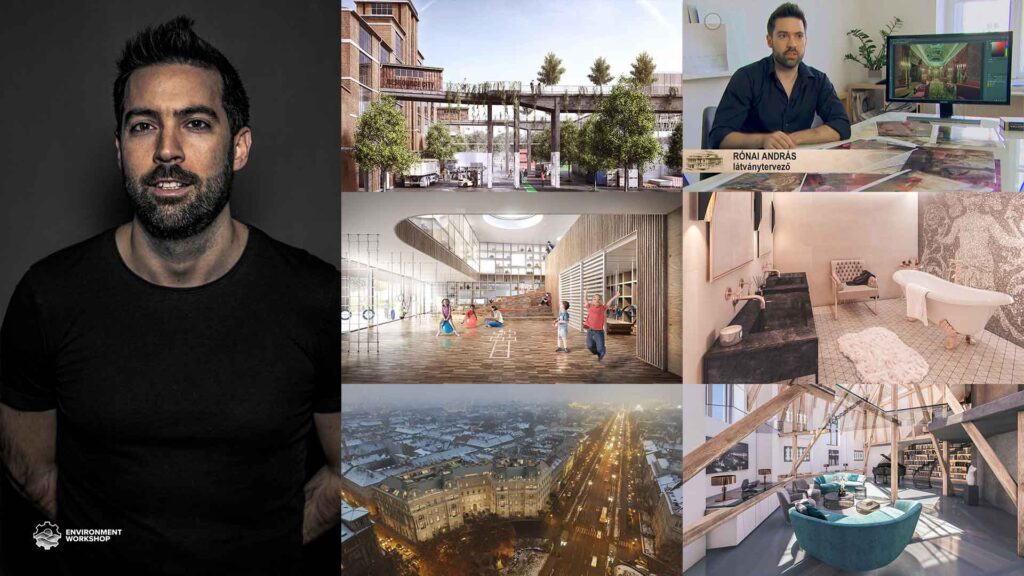
My story starts with studying architecture. Somehow I drifted into 3D visualization, which back then meant rendering still images in V-Ray for architectural projects. Just the usual archviz life.
I was freelancing, which sounds great in theory. “Wow, you work for yourself with no boss!” – that’s what people said. In practice, it looked like this: I worked a lot, earned okay, and every single project felt like starting the grind from zero again.
As the years passed, I slowly faded into the work. Sure, I had projects, sometimes several running in parallel. But the all-nighters, waking up at 3 AM just to hit the render button again, the lost weekends… it was all quietly pushing me towards burnout.
I always loved 3D. There was something about making the worlds in my head visible that genuinely moved me. But somewhere along the way, that spark faded, and what was left was just tedious grinding. Year after year, roughly the same work for roughly the same money.
And the worst part? I knew that if I didn’t change something, I’d be living the exact same life five years from now.
The first glimpse of something different
Then in 2012, something happened.
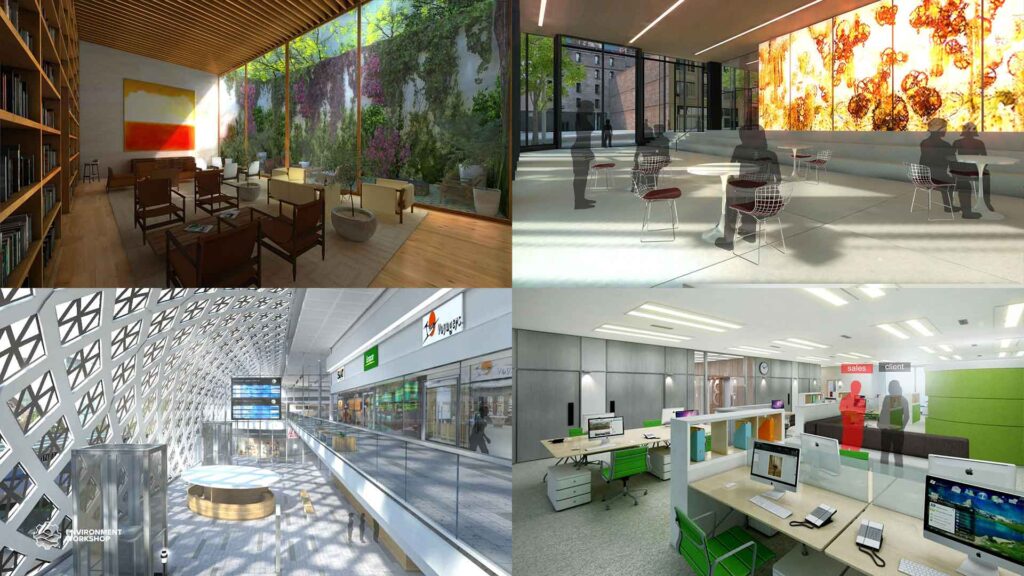
I joined a company that worked with a custom-built 3D software. We created walkable, interactive scenes, mostly for international clients, often world-famous architecture firms.
You could walk through these spaces in real-time. Multiple people could connect simultaneously from anywhere in the world. We’d point with laser pointers, measure dimensions, talk to each other – all inside the program.
Back then, this felt like technology stolen from a sci-fi movie. It was way ahead of its time, and I felt like I’d finally arrived. This was the technology I wanted to work with.
That passion I’d felt at the start of my career? It came back. Like opening an old project folder you’d forgotten about, and realizing: “Damn, I made this. And it was actually good.”
And then I left
When I left that company, I lost my connection to the real-time world for a while. I went back to offline rendering, kept doing the work. But something was stirring in the background.
I was like someone who’d seen something once and couldn’t get it out of their head. Like I’d taken the red pill in The Matrix: I couldn’t go back to what I used to think was normal.
So I started searching. Maybe there was something else out there. Something that could recreate that feeling.
And that’s when I ran into Unreal Engine 4.
2014: The moment everything shifted
Back then, Unreal was mostly used for game development, but it was starting to infiltrate into the architecture world too. I found a few archviz pieces on YouTube. And I’m not exaggerating: I sat down, started watching, and just stared at the screen with my mouth open.
Full quality graphics. Completely photorealistic. All of it running in real-time at 30fps.
I watched these videos like they were alien technology, and meanwhile I knew this was software anyone could download for free. Tim Sweeney at Epic Games was clearly thinking in a completely different business model than most software companies.
In that moment, the decision was made: I want to do this. Now.
I downloaded Unreal, opened the Editor, and… honestly? My first reaction was: “Jesus… what am I supposed to do with this?”
The interface looked like an airplane cockpit. Buttons and panels everywhere, and I had no idea where to start. But the motivation was there, so I dove in.
The tutorial-hell era
Back then, there was no clear learning path. Information was scattered across forums, documentation, random articles, YouTube videos – as fragmented as it could possibly be. There was no system for people who wanted to actually learn the software properly. Nobody told you where to start or where to go next. Everyone said something different. Every source had a different starting point.
If I searched “Unreal tutorial”, I got gameplay and Blueprint logic. But I wanted to make beautiful, photorealistic environments, and back then, there was almost nothing for that.
So I started experimenting. And it looked like this: when something worked, I often had no idea why it worked. When something didn’t work, I had no idea what to change. That was my “learning system”.
Meanwhile, I was working 10-12 hours a day on my existing projects, so most nights I’d start learning Unreal around 10 PM.
Some days I felt like I was making progress. But then weeks would come where I’d get stuck on something small for days, with no visible progress at all.
And sometimes I wouldn’t touch the software for weeks because I was completely buried in work – and life has to happen somewhere too. By the time I came back, I’d forgotten half of what I’d learned.
This is the classic yo-yo effect. Progress, get stuck, stop, come back, can’t remember much, start over. If there was one thing that frustrated me deeply, it was this dynamic.
My knowledge was like a pile of Lego: lots of scattered pieces, but no complete picture.
The moment it all caught up with me
And that came back to bite me.
At the end of 2017, I took on two live, paid projects simultaneously. International clients, serious expectations, tight deadlines. In Unreal. These were exactly the kinds of jobs I’d always dreamed of.
And then that dream slowly turned into a nightmare.
I realized that everything I’d been doing under the label of “learning” hadn’t given me an actual, usable, well-practiced workflow. I didn’t have a stress-tested pipeline, a system I could build on.
When I hit a problem, I couldn’t solve it quickly. I just jumped between sources, hoping to find the specific answer. What worked at hobby level was way more precarious when there were real expectations and real deadlines. Working on live projects is a completely different game.
And that was the moment I realized: I urgently needed something different.
The turning point
Around that time, really professional English-language courses started appearing – courses that went deep on the artistic side: lighting, materials, composition, photorealistic rendering.
I invested money and time into proper training, because I had no other choice. And here came the surprise.
In one week, I made more progress than I had in months before. Because I finally got what had been missing the whole time: the sequence, the logic, the why behind everything. I didn’t have to figure out what the next step was, it was laid out for me. I knew where I was, where I was going, and what came after.
Looking back with my current perspective, the problem was never “I can’t learn this”. The real problem was how I was learning: scattered, without a plan, randomly, always chasing whatever happened to appear in front of me.
What opened up after that
Once I started learning and working in a structured way, I got better. I developed faster. I could put increasingly serious results on the table. And because of that, doors started opening.
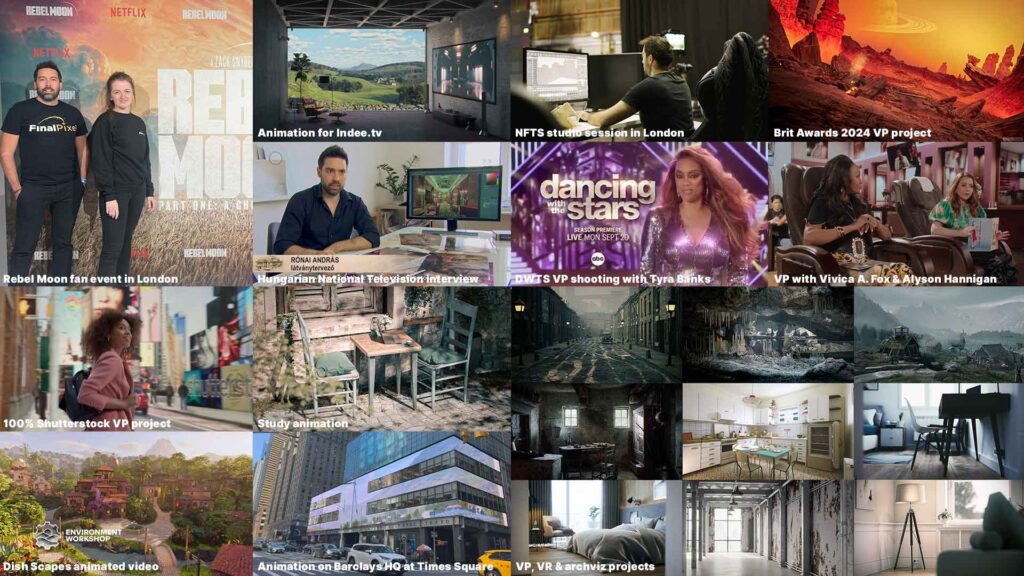
I specialized in environment design, and bigger opportunities started coming in. I joined the British-American studio Final Pixel as a remote artist, and through them, I got into international virtual production projects.
I worked with Oscar winners and Emmy-nominated professionals. The LED wall environments I built had celebrities standing in front of them: Alyson Hannigan, Tyra Banks, Vivica A. Fox and David Olusoga.
I was flown to London twice for studio work. One of those projects was a fan event for Netflix’s Rebel Moon, where director Zack Snyder visited.
As a Hungarian guy, working remotely from Hungary, ending up in that kind of environment – that part still feels unreal to me.
The realization that brought me here
And this is where the next insight hit me.
What I went through – the excited start, the chaos, the yo-yo effect, the dead ends – people are still going through the exact same thing today.
Most people don’t give up because they’re “not capable”. They give up because there’s no clear path. The internet is full of content, but content isn’t the same as progress.
I want you to see that I started exactly where you are now. And if I – with all my stumbling, all my dead ends – could get here, then you can get somewhere too. Maybe it won’t be London. Maybe it’ll be something completely different. But every path starts somewhere.
The Bootcamp is about taking that first step together
You won’t be fumbling around alone on YouTube. You won’t have to figure out what comes next. You’ll get a sequence, a structure, and in 4 days you’ll have a tangible result: something you built.
And who knows? Maybe one day you’ll be standing in front of an LED wall too, thinking to yourself: “This is why I learned Unreal”.
See you Monday evening, at the first session.
Ciao,
András
If you have any questions, just drop me a message and I’ll help: andras@andrasronai.com
Privacy Policy | Cookie Policy
© Copyright 2026 All rights reserved
All textual, audio, and visual information on the website is protected by copyright.